
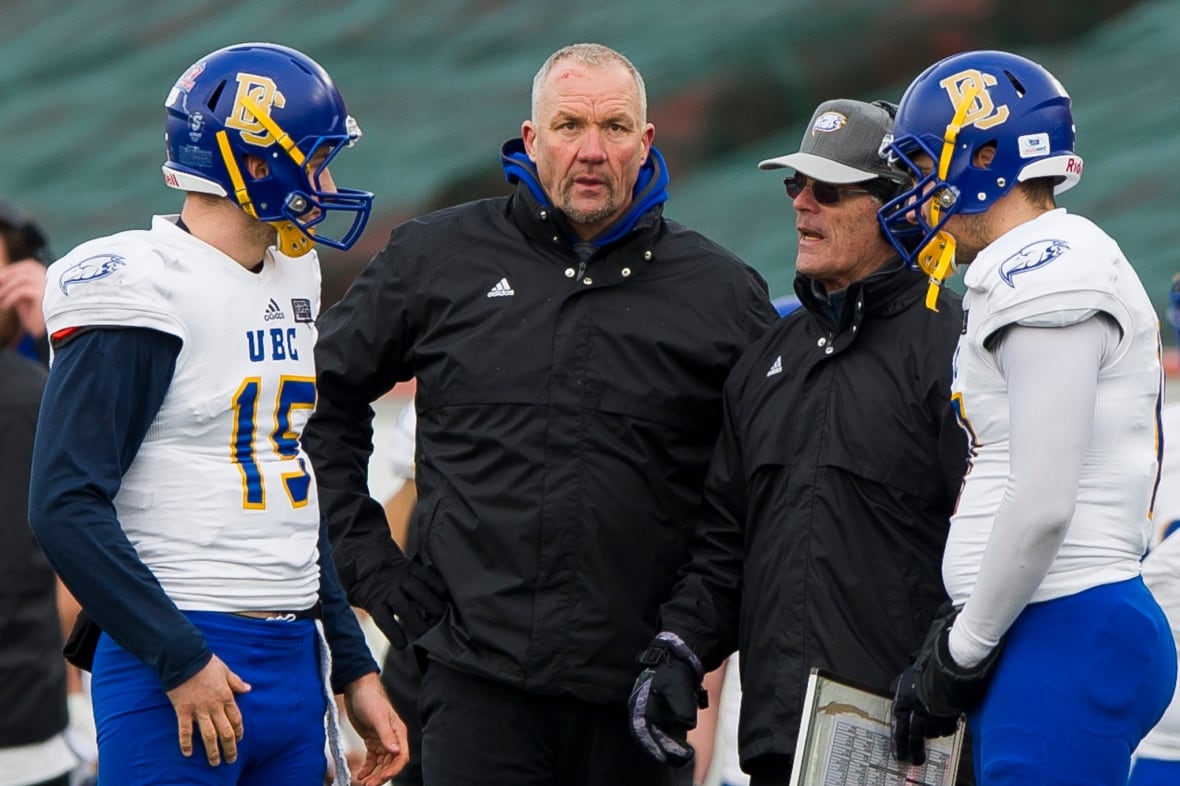
Before Blake Nill was a Frank Tindall trophy winner or a three-time Vanier Cup champion as a coach, he was a hulking 6'6" defensive lineman from small town Hanna, Alta. at the University of Calgary in the 1980s.
After three seasons of CIAU football with the Dinos, Nill was selected in the third round of the 1983 CFL Draft by the then Montreal Concordes. He converted to an offensive lineman his rookie campaign and spent four years with the Alouettes franchise to begin his career. After 44 games in the pros and short stints with the Blue Bombers and Tiger-Cats, Nill hit the East Coast to pursue a career in education. But football wasn’t done with him just yet.
In 1992, while enrolled in a Master's program at St. Francis Xavier, Nill began as defensive coordinator with the St. FX X-Men. His tenure with the X included an appearance in the 1996 Vanier Cup game, a team enshrined in the St. FX Hall of Fame. With a burgeoning reputation in the AUS, Nill was yet to truly leave his mark on U SPORTS football.
Atlantic football reached new heights when Nill took the helm of the Saint Mary's Huskies in 1998. He was of course the U SPORTS coach of the year the following season, and won back-to-back Vanier Cups in 2001 and 2002, one of only five teams in U SPORTS history to win a national title in consecutive years.
Despite an unprecedented level of success in Halifax, Nill opted to return to his alma mater in 2006 to guide the Dinos back to football relevance. He did just that, leading the team to their first Hardy Cup championship in over a decade during the 2008 season.
Brick by brick, Nill laid the foundation for what would become a factory of churning out pros. The Dinos would own the Canada West crown for the next six years until 2013, and although they came up short of a national title, they made three Vanier Cup appearances.
In late 2014 Nill decided to again leave an established program for one that needed revitalization: the UBC Thunderbirds.
UBC was sputtering at the time. Due to an eligibility issue, the program was forced to forfeit their six regular season wins from 2011, and followed that up with a dismal two win campaign in 2012. UBC made the playoffs again in 2013 but were bounced in the semifinals by Nill's Dinos before failing to qualify again in 2014.
Setting the stage for 2015.
The UBC Thunderbirds advanced to their sixteenth Hardy Cup championship as a franchise over Nill's former team, the Calgary Dinos. And as if it couldn't be scripted any more perfectly, the T-Birds won their franchise's fourth Vanier Cup that year as well.
Blake Nill sat down with OB.SESSED to provide a comprehensive overview of how his teams have dominated U SPORTS for over three decades and the courage that defines his career.
With a resumé as stacked as yours, what's driving you at this point in your career?
Nill: Well, I'm looking for some more big wins. I'll tell you that, they're tough to find, for sure. But one of the reasons I keep going right now is I think our game needs balance, and what I mean by that is that there's not a lot of old school coaches left. You know myself and coach [Greg] Marshall, coach [Glen] Constantine, perhaps coach [Steve] Sumarah.
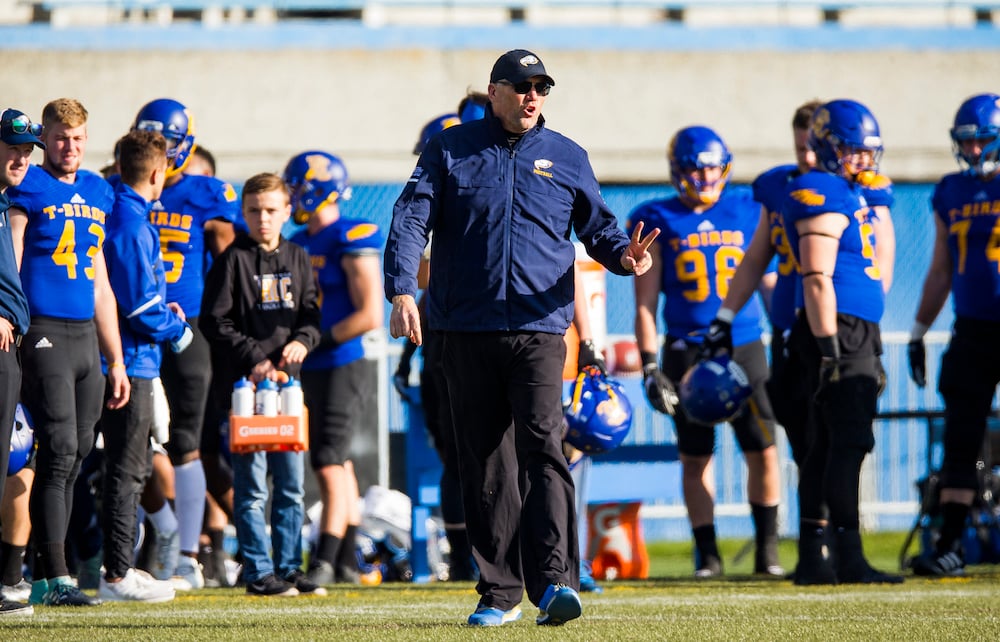
Blake Nill has won three Vanier Cups with two different programs (2001, 2002, and 2015) and was presented with the Frank Tindall Trophy after being named the country's Coach of the Year in 1999. Photo: Bob Frid/Thunderbirds
We've seen the transition and the progression of the game and I don't think it's always been for the best. So for a couple of us to keep it a little balanced, I think doesn't hurt. And I want to provide experience for the young coaches. I'm a very strong believer in the benefit of the game of football to young men and when you see the game influence young men the way it can, you want to give as many of those youngsters the opportunity as possible.
Is there a coaching fraternity in U SPORTS?
Nill: There is to an extent. I think our coaches could be stronger in unification. I actually just spoke to a coach this morning from an opposition school, and I told this young guy, you always have to remember we're working for the same outcome, and building the brand of the game — we compete when we're on the field — otherwise, we work together. And I don't think that message is as strong or is implemented enough in the current group of coaches across the country.
What was it like playing U SPORTS Football from 1980–82?
Nill: Football back in the '80s was different. Not as much science — more about toughness — more about grit. Still very team-oriented, but I don't think there was as much regard for the other aspects that make up the day of an individual. The coaches focused on football. They might get worried if you were failing out of school or not passing classes, but nowadays, most of my time is spent making sure that my athletes are surrounded with the tools to hit their athletic potential continuously. We're continuously reminded in sports science how those elements change. So it's very much more of a wellness focus for the athletes, where that didn't exist when I played.
What do you remember most about your playing days with University of Calgary?
Nill: I was just a young kid who grew up in rural Alberta. A big, strong, young kid, you know what I mean, very aggressive. Just a farm kid, basically. And what university football taught me right away, like after day one was, there's always someone bigger and stronger. It taught me how to compete, and it exposed me to how to prepare properly.
It exposed me to the weight room, it exposed me to so much. Four months after starting my first year in classes at university I started wrestling as well, something that I had never experienced before. So it definitely brought into more of a high performance type atmosphere. [I'm] very appreciative for the opportunity, and very happy I made that decision to leave rural Alberta.
Was there any shell-shock being picked by the Montreal Concordes in the CFL draft in 1983?
Nill: I was very excited to go play football in Montreal — a huge, huge change of venue for a small town kid — it was big enough going to Calgary, and then all of a sudden you're in Montreal in the heyday of the [MLB’s Montreal] Expos, and the [NHL’s Montreal] Canadiens were at the top. Incredible experience for a young man, and again, very grateful for the people I met and opportunities I had in Montreal.
What was the most fulfilling part of playing in the CFL?
Nill: First of all, the friendships that you make at that time were very important. And again, I was very young, so I made long term friendships with not only players, not only teammates, but coaches. Wally Buono, for instance, was on our staff when I was first at Montreal. Miles Gorrell was a teammate of mine, and I have so much respect for Miles. During his scouting career in the CFL and his administration career in the CFL, I felt very few advocated for Canadian athletes the way Miles Gorrell did, and so to get to know Miles to that extent was incredible.
But again, the game was different back then. There wasn't a big wellness component. So everyone talks about players who come from the '70s and '80s and repercussions from playing the game the way we did. [It] might not've been the smartest when you play with broken hands and broken feet, and you're just told to suck it up, but that was just the way it was back then. Just a tremendous experience, and it certainly has helped me as I'm going into my fourth decade of leading young men in this regard.
When did you know you wanted to coach?
Nill: I was in Calgary with my young family. We just had one child then, and I remember telling my wife at the time, there has to be something better. I thought, given my background in athletics, that I could coach high school football or something. I was working with youth at the time, and so if I was going to work with youth, I thought, I might as well be a teacher. My wife, at the time, her family had a long history at St. FX and we applied to education at St. FX to get in and out of there as quick as possible and move on to a teaching career.
And when they saw my resume, [Dr. John] “Packy” McFarland, the [athletic director] at the time, he's the guy that got me started, he said, 'Look, we'll bring you to St. FX, but we want you to coach football.' And I met him, we flew into Toronto. He flew from Halifax to Toronto. I came from Calgary. We met and he sold me on St. FX, and he said, by the time you're done, you're gonna have a degree that enables you to teach at high school, which is what I needed.
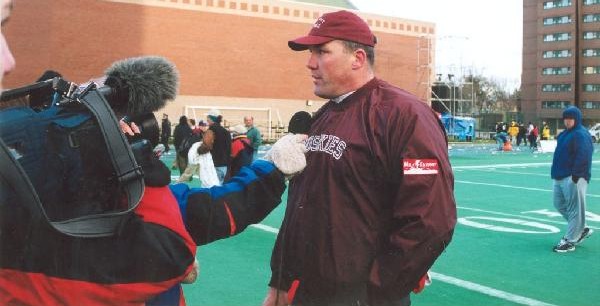
Nill is seen talking the the media at Saint Mary's University during the 1999 season following the Huskies' AUAA championship (now the AUS). Photo: Saint Mary's University/Provided
So they put me in the bachelor of science in physical education at X, which is a prelude now to what's called kinesiology. Part of the day I was a coach, part of the day I was an instructor in the phys. ed. department, and part of the day I was a student in the phys. ed. department — and it was the most incredible six years.
Then when I graduated from that degree in ‘96 I wasn't ready to leave X yet. So I thought, I might as well do this masters, because it'll help me with other schools if I want to stay in coaching. And I sort of grinded my way through that, that wasn't as enjoyable as the undergraduate. But a good friend of mine — Greg DeLaval, who was a player for me at X, an assistant for me at Calgary, an assistant for me at UBC, and he was also the head coach at U of T — him and I enrolled in that masters together. And for two years, we did everything to stay afloat but we got through it together.
How did the opportunity arise at Saint Mary's in 1998 ?
Nill: That's the only job I've ever applied for, was Saint Mary's. I remember I applied for the job, and if I wouldn't have got it, there's a good chance my life would have taken a different path. But it came off two big years at St. FX. [In] ‘96 we made it to the national championship — we eventually lost to Saskatchewan in the Vanier Cup — then in 97, St. FX was ranked number one in the country most of the year and we lost in the conference.
But still, with the X program under John Stevens and I was part of that, I was starting to garner some reputation, at least in conference. And when I applied to Saint Mary's, I didn't hold out a lot of hope, but I was leaving for work at X one day, and my wife called me, and she said the phone called, and it was [Canadian Football Hall of Fame] coach [Larry] Uteck, and he offered me the job, and your life just changes. So, very grateful for that.
How was Atlantic Canada able to dominate U SPORTS in the early 2000's?
Nill: When I was at St. FX (1992–1997) and then Saint Mary's (1998–2005), [the AUS] easily held their own, and even you could say, dominated U SPORTS at the time; in hockey, in basketball, and football.
And what happened is, funding. They weren't able to have the vision to deal with when Ontario got scholarships and when Ontario voted to allow scholarships to be given to varsity athletes (2005). It changed the way the game was played. It changed the recruiting in all sports. Atlantic Canada missed the opportunity to stay ahead of the game by not adjusting correctly, and now they're trying to catch up.
My time in Saint Mary's from 1998–2005, we dominated the sport brand in Halifax — it was us and the Mooseheads — and even the Mooseheads would do everything they could to avoid playing on the same day as we did, because Huskies football was everything. The brand was huge, and I'd like to see it back there. I really believe Canada U SPORTS football would be much stronger if the Atlantic schools were able to regain some level of national competitiveness.
With the run you were on out East, what enticed you back to Alberta in 2006?
Nill: If I would have stayed at Saint Mary's my first recruiting class alumni would be in their late 40s. The money we'd be bringing into Saint Mary's right now — we'd be unstoppable, we practically were then — and this isn't anything to downplay Laval or even coach [Greg] Marshall at Western, but we would have been, all things staying the same, Saint Mary's would be untouchable. It probably would have reshaped football in U SPORTS if I'd have stayed there.
This is a true story, I was at the office at Saint Mary's, and I just heard that Calgary let Tony Fasano go. And I drove home like normal, and I talked to my wife, and I said, we should go on a holiday, or we're going to end up in Calgary. And she asked ‘Why?’ And I said, well they just fired their coach, and that phone, I'm almost certain is going to start ringing by the end of the night. And honest to god, within 20 minutes of that conversation, the first Calgary alumni called, then the second, and then it was a total blitz for like three weeks, and I was trying to hold off.
At the time, Calgary had struggled for a decade, and there's a lot of big egos and a lot of oil money in that program, and they don't take no very easy. So we were out and back and out and back, and eventually, they were guys I had played football with and I'm thankful that I had the courage to take a chance.
Because it really was a tremendous sacrifice for my family…we were so embedded in the Halifax community. My oldest boy was at the same junior high as Brad Marchand — Sidney Crosby would come to the weight room at Saint Mary's all the time, and I would get him to come out and talk to my young campers, like it was big time — and somehow I found the courage to leave, and again, I think it helped define the type of coach I've become.
How did you transform that Calgary roster from lower echelon into a buzzsaw?
Nill: Taking the challenge when I came to Calgary in '06, the last time they had won a playoff game was the 1995 Vanier Cup, and we were god awful. We were so bad. When I took over the team we were just terrible, like the athletes were just terrible. I remember my focus was on getting a quarterback and one of my former teammates in Montreal, was Lloyd Fairbanks, who's a Hall of Fame football player.
He was coaching at Raymond, Alberta. They had a quarterback, and most Raymond kids I know now don't want to play in Canada. They want to go to the U.S. [like] the Ralphs; all the Mormon kids. Somehow I was able to convince Dallin Tollestrup to come to Calgary, and that changed how recruiting went because he was the biggest name in Alberta. I only had him for one year, because he went on a mission, and then he went to [Brigham Young University].
But in that one year, Calgary football changed, and then we just never lost an Alberta kid that we wanted. Although we missed on the biggest games, the three Vanier Cups with me for six years and for four years after I left, that Calgary program went from not winning a playoff game in a decade to winning nine in 10 years in Canada West, which is the most competitive conference. We basically eliminated Saskatchewan from any type of Hardy Cup success — Manitoba snuck in one year (2007) and UBC in my first year there (2015)...other than that, we dominated it. We lost some big games but they were on the road, playing Laval in Quebec City (2010) is a tough chore.
The Queen's loss (2009) will always be the toughest one I had, because it was just very difficult. Maybe the team that I'll always think back on is 2013 because in 2013 we had won five Hardy Cups previously, but I lost 19 out of 24 starters going into the season. The entire front seven was drafted and played in the CFL. I lost basically everyone I had. I had Sukh Chung and Sean McEwen on the O-line left, and my quarterback [Eric] Dzwilewski was player of the year the year before.
We were chosen that year to finish last in Canada West in the coaches poll. We started the season in UBC, and Dzwilewski broke his foot in the first quarter. So I had to start Andrew Buckley at quarterback, and with three minutes left in the U SPORTS season, Calgary's 11-0, and beating Laval in the Vanier Cup, and we just couldn't finish, we just didn't have the maturity.
I remember at the end we were driving to go up two scores, and we fumbled the football — and [Constantin] came out and put like seven O-linemen on the field, another one in the backfield. We just didn't have the physical maturity to deal with it. But that was a tremendous year for the University of Calgary Dinos and I'm very proud of that particular group.
UBC was another struggling football club when you took over in 2015, what made you take this job?
Nill: 2014 we're playing UBC in their homecoming and the score got out of hand. It got out of hand. It wasn't a very good moment for UBC football, and I'm leaving the field, and another old Montreal teammate of mine, Jerry Dobrovolny, approaches me, and he says will you take a call at the end of the year? And I said, ‘yeah, sure’. And the same thing [happened] that happened at Calgary.
All of a sudden, you're inundated by these former Thunderbird players who just want to make a difference and to be honest, they're probably at a level higher than a Calgary alumni, in terms of, well, flat out, what they're capable of doing — and I couldn't say no. Because I had had the courage to leave Saint Mary's, I knew I left Saint Mary's at the top of the country.
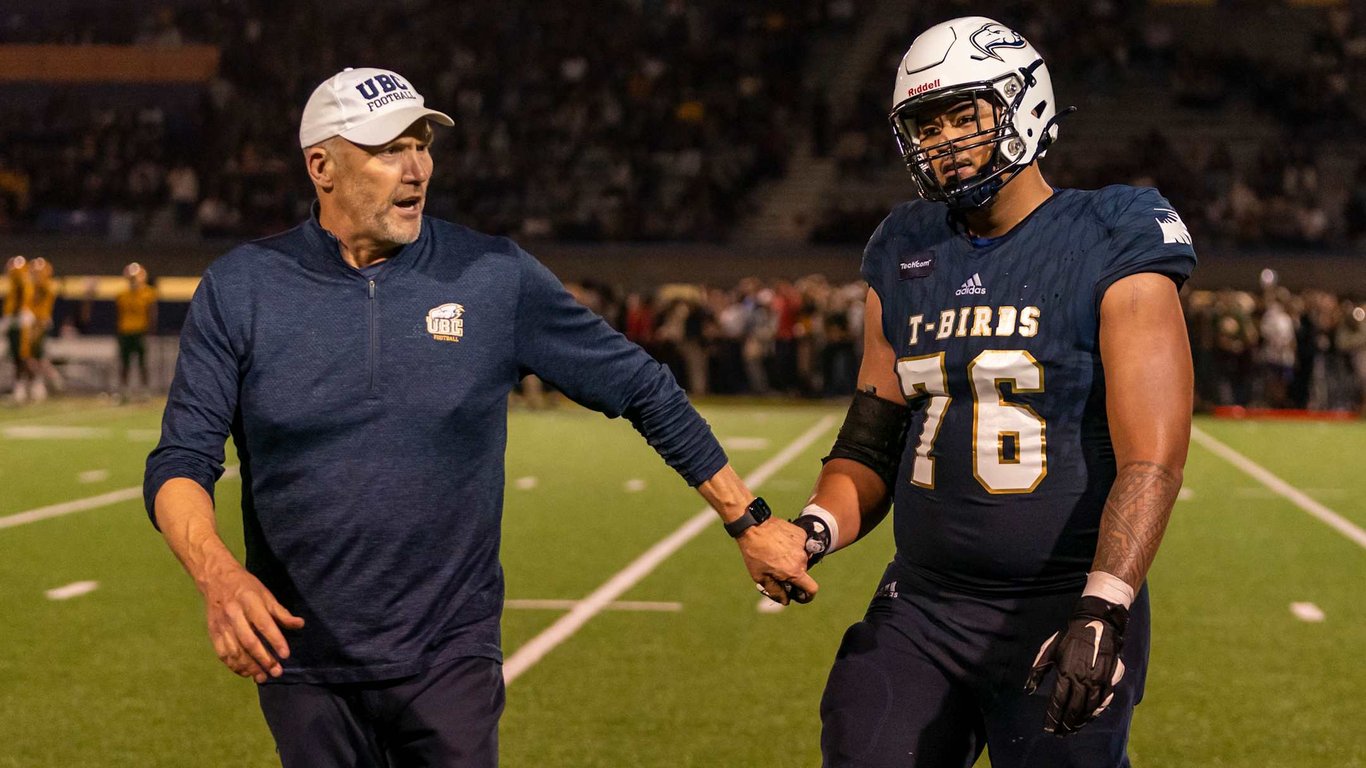
Nill has turned UBC into a prospect factory, graduating over 30 players to the CFL Draft since he took over the program in 2015. In April of 2024, 6'7", 354-pound offensive lineman Giovanni Manu would become the first Thunderbird drafted to the NFL after he was taken in the fourth round by the Detroit Lions. Photo: UBC Thunderbirds/Provided.
I knew Calgary was at or near the top of the country, and I knew that I could leave for a new challenge, and when I told you that the courage to leave Saint Mary's would define my career, it's the same courage I used to leave Calgary, and life would have been a lot easier just sitting in Calgary, but I would need a new challenge. It's been a lot of work, but a lot of successes, even though the titles aren't at the same level as the other two schools, we're a good football program here.
Did you have mixed emotions lining up against Calgary in the Hardy Cup your first year with the Thunderbirds?
Nill: Yeah, pretty intense. It's basically like a you versus the world type, you know? You're playing in Calgary, Hardy Cup. Every one of those kids on the Calgary team was a recruit of mine. There might have been one or two that weren't, but [Sean] McEwen was there, Buckley was there, [Rashon] Simonise was there. They're all there...and you're like public enemy number one as it is.
I'm there with coach [Steve] Buratto, who was with me at Calgary, and coach DeLaval who was with me at Calgary. And what that did is we knew the Calgary program. We knew the Calgary coaches more than anything. When I think of some of those teams I had at University of Calgary that fell short of the Vanier Cup, and I think about the athletes we have at UBC that won the Vanier Cup, I just shake my head, because we had some good athletes, for sure, but we also had a lot of guys who I don't think could play for me at Calgary on that team.
What I've learned from UBC is that you can be the best team and it's still going to come down to the actions of an 18 year old or a 22 year old, that will make the difference and so, like I said, we haven't had as many of the big wins as I had at Calgary and Saint Mary's, but, man, we're in it every year and we develop kids.
The amount of pros that we're pushing out is a tribute to the kind of athletes and the kind of development that my coaching staff and my strength and science team are… just a tribute to their skill sets. The best thing that I do as a coach is I surround myself with the talent of my staff, my recruiting staff, my therapy. I think maybe that's my biggest skill, is to recognize the value of someone and to try to coerce them or to gain their confidence to work alongside of me.
The CFL and/or NCAA must have expressed interest at some point, but what has kept you in U SPORTS all these years?
Nill: You're right on both those assumptions… but U SPORTS football and Canada West football has tremendous entertainment value. A lot of what I do now is try to protect the brand of football. I'd like to see more of my colleagues be as motivated to do that as I am. I spend a lot of time talking with athletic directors and corporations about the value and what we bring not only to the development of young men in this stage… our world's changed so much, but we bring old fashioned values.
We bring old fashioned work ethic, time management, discipline. And we're exciting. We're an exciting game. One year at Calgary, one of my [athlete's] parents was John Forzani, the CEO of Sport Chek and the owner of the Stampeders at the time. And John would park a lawn chair in the south end zone and watch the Dinos practice. And we would talk a lot, and he would always say, "I don't know why I pay pros… I could surround this product with my marketing machine and my game day event team, and the fans wouldn't even know the difference."
And I took that to heart. [I] always advocated strongly for the entertainment value and the brand value of U SPORTS football in this case, but I know there's other sports that could do much the same, and so that keeps me motivated a lot, and generally, I'm a very strong advocate of our product.