
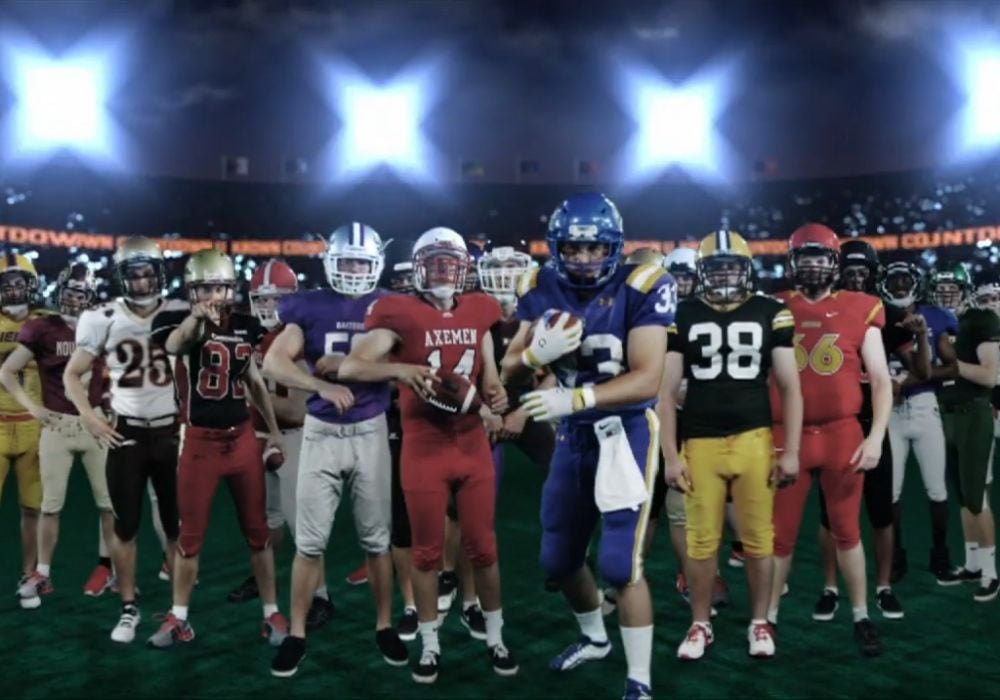
In 2015, Saskatoon businessman L. David Dube and Vancouver-based broadcaster Jim Mullin set out to increase the prominence of U SPORTS football by proposing a nationally televised, inter-conference game of the week. The new national broadcast was slated to begin in the fall of 2015 with an eight-team field selected by CIS (which soon rebranded to U SPORTS, in 2016) and other stakeholders of the new concept.
CEO Gord Grace told TSN at the time
Greg Marshall told the London Free Press

2015 wasn’t the start of the process to put the CIS on a national televised stage. Dube and Mullin had already accomplished that… sort of. To promote the 47th Vanier Cup, which was hosted on Friday, November 25, 2011 at TD Place in Vancouver, Mullin devised a national U SPORTS highlight show.
The show first aired as CIS Countdown on Shaw TV across Western Canada in September 2011 with Mullin hosting, and he tapped two young local journalists to appear as commentators on the show: Chad Klassen and Andrew Wadden.
Klassen had recently finished a graduate program in Broadcast Journalism from the British Columbia Institute of Technology. While an undergraduate student at Simon Fraser University, he had also served as the sports editor for The Peak, the university’s student newspaper. Wadden, meanwhile, graduated from the Vancouver Institute of Media Arts (then the Columbia Academy) with a broadcast arts degree in broadcast journalism.
After 10 episodes in 2011 leading up to the Vanier Cup, Dube joined the picture. The owner of Krown Produce, Dube was already the title sponsor of Canada West Football on Shaw TV, and would now add his brand to the highlight show now dubbed Krown Countdown U.
The two men were firmly behind growing the CIS football brand nationally, with the show “covering all 27 teams nationwide and […] broadcast on six cable systems in 20 CIS football markets in nine provinces, and nationwide to 900,000 subscribers on Shaw Direct” beginning in 2012.
Rogers’ cancellation of the OUA Game of the Week on Sportsnet 360 after 2013,
The Business Plan
From 2002–2016, Bishop’s University played in the RSEQ, making for unbalanced fields in both eastern conferences.
But after crunching the numbers that season, organizers concluded by late October that the most sustainable path to a permanent series involved participation from all conferences, according to the final business plan presented to schools.
"The concept was shared with the CIS office in November, an informal meeting took place with coaches from all conferences on the Friday before Vanier Cup. CIS and some conference directors were engaged shortly after. There was another meeting in Toronto in December with Laurier AD Peter Baxter observing for CIS, Gord Grace representing OUA, five OUA coaches, three Canada West coaches, one RSEQ coach, Mullin and Dube. Many of the recommendations to the conferences and ADs are contained within this document."
The plan was ambitious. It didn’t just involve a turn to national conference play, but an eventual rewiring of the entire U SPORTS football ecosystem. One pillar was weighted scheduling, which aimed to reduce the number of blowouts and match perennial conference bottom feeders up with bottom feeders from other conferences who they would be more competitive with.
Of course, this would also create more marquee matchups. For example, Western has never lost to York. Save for an 11-9 thriller in 2007, every game has been a blowout. In the 13 games between the programs, Western has beat York by an average score of 61-8. Yet almost every year, one of Western’s eight games is tied up with a matchup that neither side’s fans are excited about.
Under the proposed format, York could replace that game against Western with a more winnable crossover into the RSEQ, while Western could take an early season shot at Saskatchewan or Laval.
Another pillar was a change to the national playoff format. Instead of all four conferences being treated as separate-but-equal, the proposed private non-profit partnership would develop a modified rating percentage index (RPI) to rank team and conference strength and judge playoff entrants accordingly.
A December Meeting in Toronto
Coaches were on board with the initial proposal Canada West-OUA interlock for 2015, which would see all Canada West teams participate in a one or two game series with the top six OUA teams. But Mullin and Dube preferred a true national conference, arguing that the Northern 8 concept was the only way to make a “national footprint.”
For 2015, the Northern 8 group would asks teams for $30,000 up front to handle airfare, and divide those airfare and business costs equally between the teams. If there was any remaining profit, it was to be distributed to non-participating programs.
“We have concluded that due to time constraints in regard to planning along with the creation of a structure which can meet long term objectives of sustainability, the Northern 8 is recommended for implementation in 2015. The investors are focused on 2015, as the Canadian broadcast landscape is in a state of flux in regard to sports properties and broadcaster partnerships.”
The recommendation was that AUS-RSEQ interlock would remain, but powerhouses Laval and Montreal would be pulled away to play nationally against the top two Canada West teams from 2014 (Calgary and Saskatchewan) and the top four OUA teams from 2014 (Western, McMaster, Ottawa, and Guelph). The eight teams made up the proposed Northern 8.
2015 Northern 8 Schedule
Home | Away |
McMaster | Laval |
Calgary | McMaster |
Guelph | Calgary |
Laval | Guelph |
Saskatchewan | Western |
Western | Montreal |
Montreal | Ottawa |
Ottawa | Saskatchewan |
The recommendation followed that 2016 would see a similar Northern 8 schedule, with teams decided by conference placing from 2015, but would add a four game CW-OUA interlock, similar to the existing AUS-RSEQ interlock. In 2017, a Northern 10 was proposed, which would expand the schedule by adding two at-large teams. A detailed planned national schedule followed for 2015 — which of course, would never end up being played.
What Went Wrong?
In February 2015, around the time of the OUA’s rejection, Mullin presented the plan to viewers on a episode of Krown Countdown U hosted by Wadden. Wadden would interview Dube following the presentation, which is transcribed in the following paragraphs.
Dube: My role in it was — clearly, aside from being a funding partner — was really strategic. It was figuring out the practicality and the strategic vision of what does a television contract look like, what does a schedule look like? What makes a compelling case for television, because CIS has been on television before, nationally, it’s been an awful long time, and we thought if we could come to the table with something that eliminated most of the obstacles that have been stopping it from being on television.
Wadden: Why do you think the discussions haven’t progressed the way you envisioned them to?
Dube: I think you’d have to ask the schools and the conferences that question and I hope people do ask them that. Really, all we’ve heard is that things have happened too fast. Where I come from, and I do understand its different than in a university setting, when you see an opportunity — and we saw a unique opportunity in 2015 in the media landscape — we wanted to take advantage of it, which means moving quickly and decisively. Some people were offput by a meeting we had with the coaches in December … I think people deserve an explanation for why we would meet with the coaches. We really thought, these coaches are the experts. When an athletic director gets a football specific question, who do they go to? They go to their expert, which is their head coach. We wanted to bounce ideas off them, start a conversation, see if there was any willingness on their part, so if an [athletic director] brought this proposal to them they would say ‘I’m interested’. If it wasn’t going to pass muster with the coaches we knew we had no chance. So if asking for advice offended some people, I can’t really help them with that.
Wadden: What has the response been like from the television networks?
Dube: Well I can tell you this: the feedback was very clear, that there was an interest in it, because the media landscape has got some voids in it, unique ones this year, that just happened to align, which we thought the stars were aligning perfectly to bringing college football in Canada back on television. They made it exceptionally clear that it had to be the best versus the best, which made us very happy, because our proposal is exactly that. It is the very best against the very best. You put your best product forward, you expose it to millions of Canadian fans who currently are watching the CFL and don’t really know where these Canadian players come from. I mean all these rosters, 196 players in the CFL come from Canadian schools, and yet we’re not exposing the product to those fans.
Wadden: Are you prepared to discuss a new pitch which would see the Northern 8 in say, 2016?
Dube: You know what, I’m always prepared to have a discussion, in fact, I welcome it. But what we need to do is make sure we’re going to going to have a discussion that didn’t happen this time that the players, the participants need to have a bit of an attitude change. Frankly, we need behaviour that is pushing the game nationally, that thinks about growing the game, and it doesn’t break down into what I consider the politics of self-interest. I congratulate Canada West, they were very open, I know Jim [Mullin] was given an opportunity to discuss it with them, and came away with the unanimous vote in favour of it, ultimately the experience thus far has been very disappointing.
Wadden: Richard Boutin, though, from the Journal de Quebec asked ‘what do you say to those in the RSEQ who said that this process was moving too fast?’
Dube: I really don’t have anything to say to them, that’s their statement. They were clearly uncomfortable that it was too fast. They seem to indicate that there’s merit, the issue is the speed. But the opportunities in 2015, I think I’ve made it pretty clear today I’ll engage in a conversation with willing participants who can set aside any biases and say ‘can we move forward’. But the real opportunity was right here, right now. Will it be there in [2016]? I’m not sure.
Wadden: At this point, what’s the future of this project?
Dube: I think that there’s still tremendous potential to grow the game nationally and get it back on television and show people what it’s all about. I think the student-athletes deserve that experience. And I would say fans, if you want national television, if you want best-vs-best, and student athletes, if you think you deserve that opportunity, send a letter to your [athletic director]. Have a conversation about [it]. This is a community, a football community that’s got to come together to make this happen, and so that would be my challenge to our fans. And they’re rabid, great fans, we just don’t have enough of them. And when we expose the game to more people in this country, I think people will be stunned at how many more fans we’ll gain.
Wadden: What would you say to one of the fans or a school from the Atlantic University Conference, the AUS, what would you say to them in terms of how can they play themselves into something on a national level, like the Northern 8 or 10 was going to expose?
Dube: Well Northern 8 was growing to Northern 10 in Year Two, that was always the proposal. And so, we want it to be national, but it can’t be a quota system. It’s got to be, earn your way in and it’s a best on best. You can earn your way into this and people can fall out of it. We may think that it’s always going to be certain teams, that’s not the nature of sports. So if I was in Atlantic Canada, and I know they’re fervent fans of college football, and I love the coverage out east, because you know what, they’re small schools and they punch way above their weight — they’ll qualify. It’s not an arbitrary decision made on anyone’s part, it’s going to be a formula, how you get in and how you relegate out.
Wadden: Where do we go from here?
Dube: We’re going to work with Canada West on how to package, market, and grow the game in Western Canada. It’s a great product in Western Canada, we have tremendous parity in the conference and getting better all the time, so we’re going to work with them — and I guarantee you this, we’re going to make sure one hundred percent that it’s successful and people can see the way we do things.
With Bishop’s leaving the RSEQ following the 2016 season, talks of interlock play were briefly resumed between Canada West, the RSEQ, and Mullin and Dube. “In 2017, we won’t be able to change a million things, but we’re aiming for changes for the 2018 season,” said Christian Gagnon, then the athletic director for the powerhouse Laval Rouge et Or and the chair of the board of directors of the university sector at RSEQ. But by the 2017 U SPORTS AGM in June, the RSEQ backed out.
In 2017, Shaw TV shuddered operations in Edmonton, Calgary, and Vancouver, signalling the end of Canada West broadcasts on its cable network. That season, the conference moved closer to its current streaming model, offering online pay-per-view for most games, alongside a game of the week on SaskTel Max.
With Mullin out as the conference’s main play-by-play voice after 10 years, he took over as the lead anchor on Krown Countdown U, which landed on cable at CHCH in Hamilton with an on-demand version later being posted on 3DownNation. More focus was put on NCAA football, namely, Canadian players on Division I teams.
After a year of switching to broadcasting online on CBC alongside CHCH, which included the rights for major International Federation of American Football (IFAF) games, in 2019 Krown Countdown U moved to TSN. The move included a rebrand to “Gridiron Nation presented by Krown Produce,” and again increased its coverage of Canadian players in the NCAA, as TSN had and still has the rights for NCAA Football games in Canada.
Gridiron Nation now airs weekly on TSN in half-hour segments on Thursdays during the football season, with an additional interview being released on YouTube each week.
with seven regular season and all four playoff games set to be broadcasted in 2025.
The failed bid leaves an interesting question, 10 years later. What if U SPORTS had accepted the television deal and introduced interlocking play?