
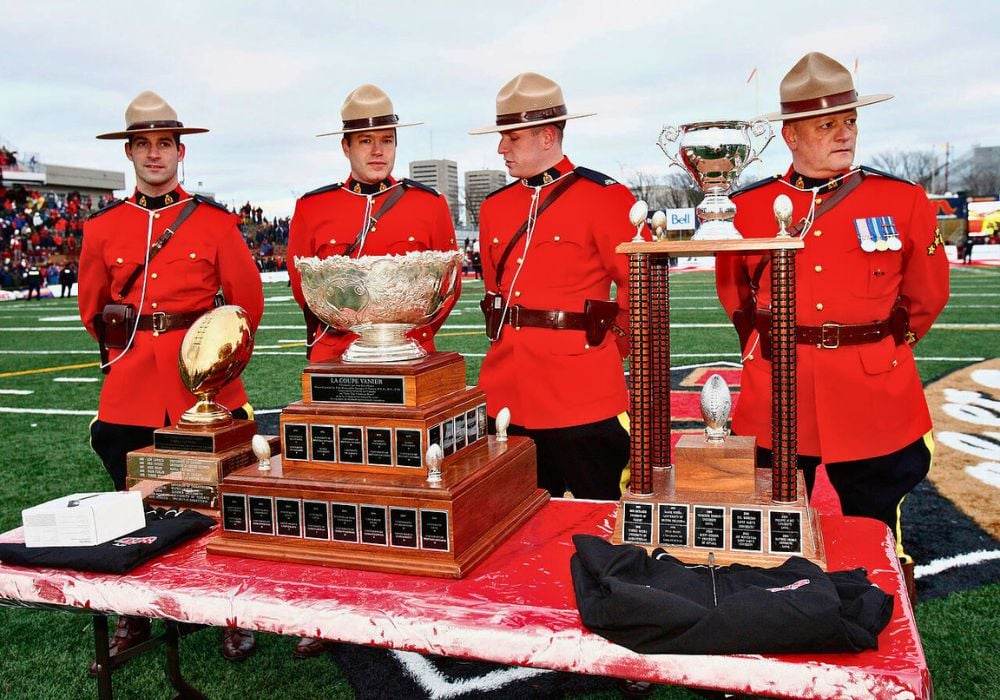

Whether this is your first U SPORTS season, or your 50th, there are probably some things that you need to know. That’s where we come in! From teams, to rivalries, to rules (yes, U SPORTS rules are different than the NFL, NCAA, and even the CFL versions) this is your guide to being the best and most informed fan this season. Feel free to use your newfound knowledge at parties, the gym, and even at family dinner. Everyone will be so impressed!

Teams
U SPORTS is comprised of four conferences, Atlantic University Sport (AUS), Réseau du Sport Étudiant du Quebec (RSEQ), Ontario University Athletics (OUA), and Canada West (CW). The 27 teams that make up these conferences are split by geographical region, so each conference has a different number of teams. The OUA leads the university count with 11 programs, Canada West comes in second with six teams, and the RSEQ and AUS each have five.
Schedule & Playoffs
During the regular season teams play eight in conference games and a gauntlet of in-conference playoffs. Because of the different number of teams in each conference, each handles their schedules slightly differently. For example, an OUA team will only play 8 of 10 possible opponents each regular season, where an RSEQ or AUS team will play each conference opponent twice in a home-and-home series. CW teams will play three conference rivals twice and two teams a single time.
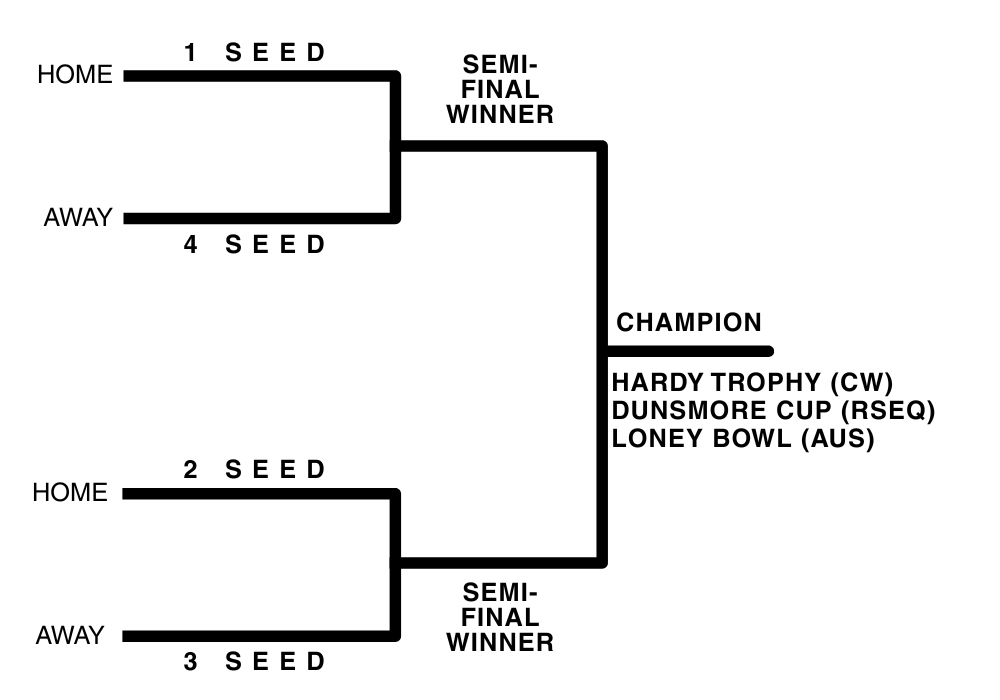
CW, RSEQ, & AUS playoffs are the easiest to understand. The top four teams play in a 1 vs 4 and 2 vs 3 bracket. The trophies are the Hardy Cup (CW), the Dunsmore Cup (RSEQ), and the Loney Bowl (AUS).
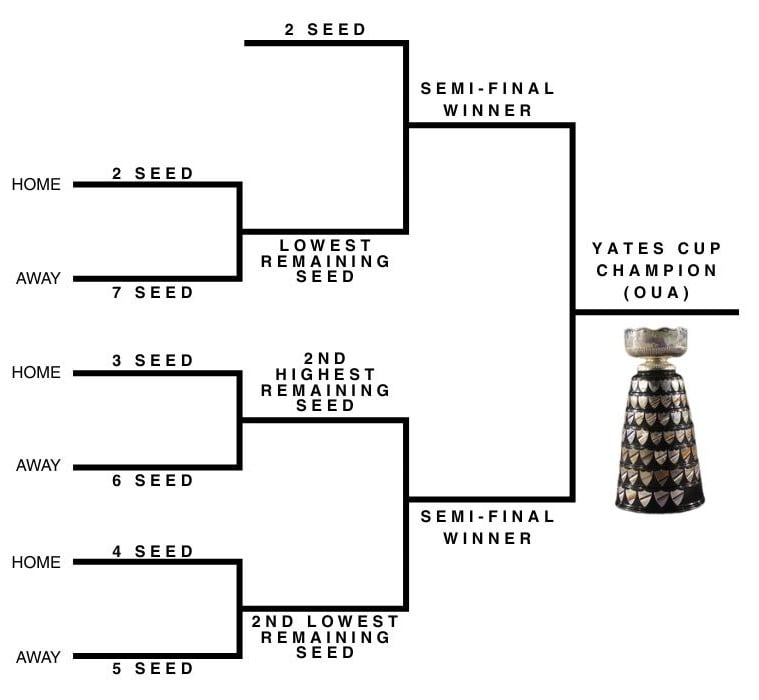
The OUA on the other hand has a slightly longer bracket. The number one seed earns a quarter-final bye, while the rest of the field play a 2 vs 7, 3 vs 6, and 4 vs 5 bracket. The OUA trophy is called the Yates Cup. Dating back to 1898, the Yates Cup was previously awarded to the regular season senior champion of Ontario until 1971.
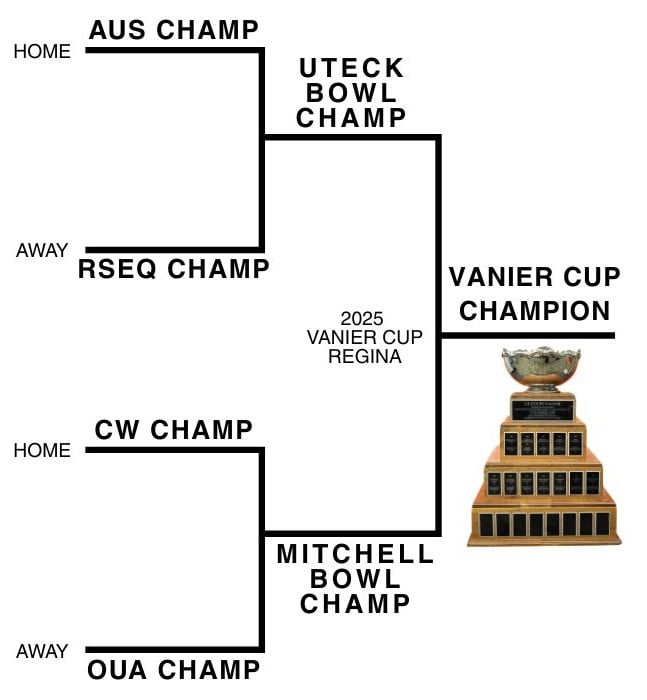
At the end of these playoffs the champions of each conference play in a national semi-final game, the Mitchell Bowl or the Uteck Bowl. These games are predetermined on a rotating yearly basis as far as which conference will play each other and which conference will host the game. The champions of the Mitchell Bowl and the Uteck Bowl then play at a pre-determined neutral site for the national championship Vanier Cup. From the Cup's inception in 1965 to 2003, this site was in Toronto, before organizers opened bids up nationwide. This year’s Vanier Cup is in Regina at Mosaic Stadium and will be the 60th presentation of the championship.
Rivalries
Each conference is filled with great rivalries, and everyone knows that a great rivalry makes games that mean more. Out of conference rivalries are rarer because teams only play out of conference games in a limited fashion, but they are not unheard of. Below are my picks for the best U SPORTS rivalries.
Laval Rouge et Or & Montreal Carabins (RSEQ)
Western Mustangs & Queens Golden Gaels (OUA)
Western Mustangs & Wilfrid Laurier Golden Hawks (OUA)
Ottawa Gee-Gees & Carleton Ravens (OUA)
Alberta Golden Bears & Calgary Dinos (CW)
Saskatchewan Huskies & Regina Rams (CW)
St. FX X-Men & Bishop’s Gaiters (AUS)
Rules
Like the CFL, a U SPORTS football field follows Canadian Football dimensions. Each team has 12 players to cover the gridiron that is 110 yards long and has 20-yard end zones. The field is also wider than an American field (65 yards vs. 53 yards). The uprights are located at the front of the end zones and are sometimes used for rub routes by receivers. They also add great drama on missed field goals which are almost always returned. Hash marks are 17-yards apart, making the field side throw an eternity. For reference, NCAA hash marks are 13 yards apart, CFL hash marks are nine yards apart, and NFL hash marks are 6.2 yards apart.
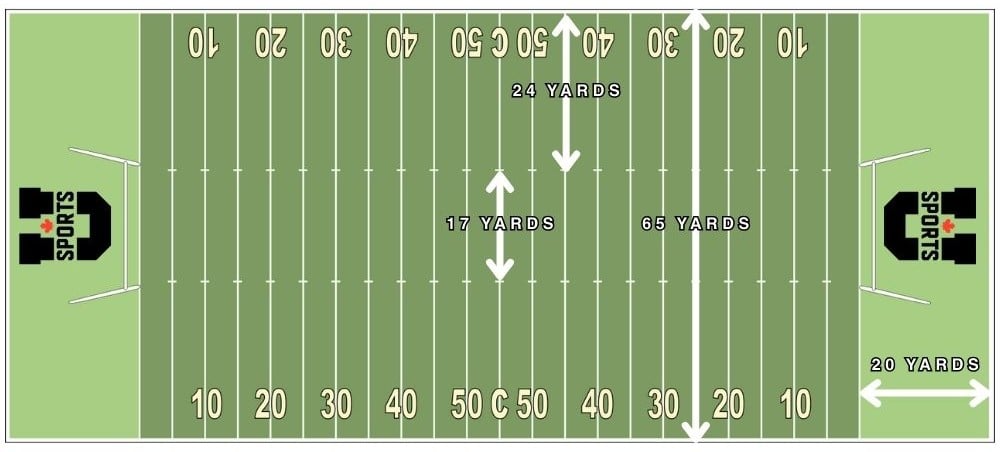
U SPORTS rules are very similar to CFL rules, with just a few tweaks. Like the CFL, special teams are essential to overall success. Punt Returners are given a 10-yard halo to field the ball, and kicking plays that are downed in the end zone result in a single point for the kicking team (known as a rouge). Along with the absence of fair catches, these factors encourage more returns than the American game.
Unlike the CFL, where ‘no yards’ penalties are all 15-yard infractions, U SPORTS differentiates between a punt caught in the air, and a bouncing ball. If a punt hits the ground before the halo infraction occurs, it is only a five-yard penalty opposed to the 15-yard in air violation. Another difference between U SPORTS and CFL rules is that there is no penalty for a punt out-of-bounds in university ball. The CFL only allows punts to cross out of bounds through the air between the goal line and 15-yard line. U SPORTS punters can kick out of bounds all they want penalty free.
Punt formations are also a little different in university. Because box players are not held at the line of scrimmage until the ball is kicked (Like in the CFL and NFL) you’ll see more open punt formations. This allows the players to get down the field faster and cover the punt. The same rule applies in the NCAA.
Kickoffs are made from a team’s 45-yard line and dead balls through the end zone result in scrimmage from a team’s 35-yard line (and of course a rouge). If a team punts or misses a field goal and the ball is downed in the end zone (also a rouge), the ball will be scrimmaged from the 20-yard line. These distances differ from the CFL and NFL, which have adopted a further placement of the line of scrimmage after kicks travel into the end zone to try and promote greater offensive success. A unique rule to U SPORTS football is that if a returner fields a kick in his end zone and advances the ball out into the field of play, the minimum line of scrimmage on the next offensive play will be the 20-yard line. This eliminates the risk of returning kicks out of your end zone and winding up on your own one-yard line.
Offences benefit from unlimited motion, just like in the CFL, and slot receivers can hit the line at full speed to time the snap of the ball (called a waggle). They also benefit from a one-yard neutral zone, meaning the defensive line must line up one yard off the ball. The Canadian three-down system is used in U SPORTS as well, meaning that the offence has three chances to advance the ball 10 yards for a fresh set of downs.
Following classic Canadian football timing rules, there are four 15-minute quarters. There is a 20-second play clock and a three-minute warning. Inside the last three minutes of each half the clock stops every time the referee spots the ball. The clock does not resume until the referee blows the play in, giving offences a huge advantage in comeback scenarios. As long as there is 0.01 seconds left when the last play was downed, one final untimed play will be awarded to the offence (as long as the offence doesn't take a delay of game).
Like all levels of football, a touchdown is worth six points with a chance at an extra point conversion. Field goals are worth three points and safeties are worth two points. The only difference between scoring rules in the Canadian game vs. the American game is the rouge. As stated before, a rouge occurs on kicking plays where the ball is downed in the opponents end zone. It is worth one point (a classic Canadian rule).
Now you are well versed in U SPORTS football and are certified to call yourself a fan. Congratulations. Now get out into the world and spread the good word. Good luck on your journey.