

As the offseason drags on, these long summer months are when we get to have the fun, meaningless debates that remind us of why we need sports in our lives. Insert this debate. Have you ever wondered why some teams choose to have a powerful beast as their mascot, as opposed to some that lead with a figure of folklore?
This question led me to think, what if each OUA team had a team full of the real life versions of their mascot suit up in pads, and play a game of football versus each other?
I decided to flesh this theory out and create a power rankings based on how their mystical, historical, and predatory instincts translate to the game of OUA football.
12. U of T Varsity Blues
For the sake of this debate, we are operating under the assumption that the beaver True Blue is the U of T mascot playing in this competition. He comes in last in our power rankings because the beaver isn't built for direct combat, unlike most of these mascots.
Their feats of engineering represent U of T's academic strong suits but don't effectively translate to the gridiron. They lack the size and physicality to keep up in the trenches. The beaver's success in a football game could be swayed by the refereeing crew assigned to the game. If their teeth were to continuously deflate the ball, the unsportsmanlike penalties could rack up, stalling out their offence.
11. Ottawa Gee-Gees
The Gee-Gee comes from the British slang for a racehorse. An offence full of racehorses poses an interesting threat if they were to run the triple option. The caveat to this is the lack of hands a team of racehorses would have... literally. The ability to block and tackle mightily suffers without arms, hands, or paws. The Gee-Gees may score, but I don't see a world where the defence can stifle any offence.
10. Western Mustangs
The analysis is going to be similar to that of the Gee-Gees. The differentiator is that the mustang is a wild stallion versus a farm-raised racehorse. The unpredictability of these wild beasts is where the edge comes from. Their sheer muscle and size make them a threat in the open field, but a lack of coordination creates difficulty with ball handling. Similar to the Gee-Gees, their offensive capabilities are intimidating but limited. The method to victory using a squad of mustangs has to be centred around jet sweeps and power running on the perimeter.
9. Brock Badgers
Listen, I know we've all heard the tale about how tough badgers are, but this is strictly a size thing. They are small but scrappy animals who will not quit in a low-scoring war. They will bite your kneecaps but lack the physicality to match up with the larger beasts we have on this list. I give them the edge over the horses as the dexterity of a badger would win in the trenches.
8. Queen's Gaels
A Gael comes from the Gaelic language, referring to an Irish warrior. This is the first of our human mascots, who brings a different advantage that the animal mascots don't possess. The ultimate advantage humans have over animals on the gridiron is hands, and the traditional athleticism it takes to succeed at football.
Now the Gaels have football of their own, Gaelic football, which has a very different set of rules. Played more like a hybrid of soccer and football, the sport is known for its violence. According to historical lore, the Gaels fought using claymores and shields, both of which are advantages on the defensive side of the ball. Imagine trying to run the ball up the middle and coming head-on with a linebacker wielding a sword at your legs.
7. Carleton Ravens
The Ravens, the first on our run of ranking birds. The first tactic that comes to mind when evaluating the effectiveness of flight in football is how someone would defend pre-snap motion when it's taking place in the air. The raven brings a skill set to football on both sides of the ball that would baffle the opposing teams. Their ability to quickly swarm on defence, while their speed and shiftiness would be a nightmare for defensive coordinators on the other sidelines.
6. Laurier Golden Hawks
Similarly, between the Hawks and the Ravens, the aerial style of attack in football would stifle teams on both sides of the ball. The difference is the aggression hawks have over ravens when attacking prey in the wild. The speed in the air for defensive backs will force opposing teams to a ground attack, to which they can swarm faster than most other animals.
5. McMaster Marauders
The Marauders come in ahead of the Golden Hawks due to their unpredictability in nature. Technically speaking, a Marauder is not a specific type of bird, but rather a way of describing the way a bird operates. It's meant to depict a bird as a raider due to its predatory behaviour, stealing food from other birds.
This style of fighting is aggressive and fearless, both qualities that are highly valued in a football player. Similar to the other birds on the list, trench play is not going to be a strength. The speed, unpredictability, and flight are what these Marauders will need to rely on to have success in the OUA. In a head-to-head matchup with Laurier, I'd take McMaster by a feather.
4. Waterloo Warriors
The Warriors rank high on this list due to their transferable skills from medieval-style fighting to football. These Warriors are heavily trained for hand-to-hand combat, paired with the wits it takes to make adjustments on the football field. Their discipline and field awareness will be some of the best, allowing them to make adjustments and run the clock unlike most wild animals. The Warriors will be prepared for a hard-fought battle, but just like most battles back in the Colosseum, it's hard to beat a Lion.
3. Windsor Lancers
Medieval times meet OUA. The Lancers would bring their cavalry on horseback to the football field, giving them a powerful advantage. Think of how effective the power running game would be with leading blockers being on horseback with lances. The reach and speed combo would be difficult for defences to corral any runner on the outside.
For their own defence, the agility could be an issue when stacked up against an opponent who excels against straight-line speed. The effectiveness of the Lancers will all come with the coach's approach. Catching them once they reach full speed feels nearly impossible, but in an ugly slugfest, they are beatable.
2. York Lions
The explosive short-burst power of a lion will be overpowering for most opponents around the line of scrimmage. No man or bird are matches for twelve lions who smell blood. They won't use tactics to out-scheme the opponent, but they won't need to. Their predatory instincts will be enough to stop any semblance of a game plan from the opposing offence. All the opponent can hope for is that they have some players left for next week's game.
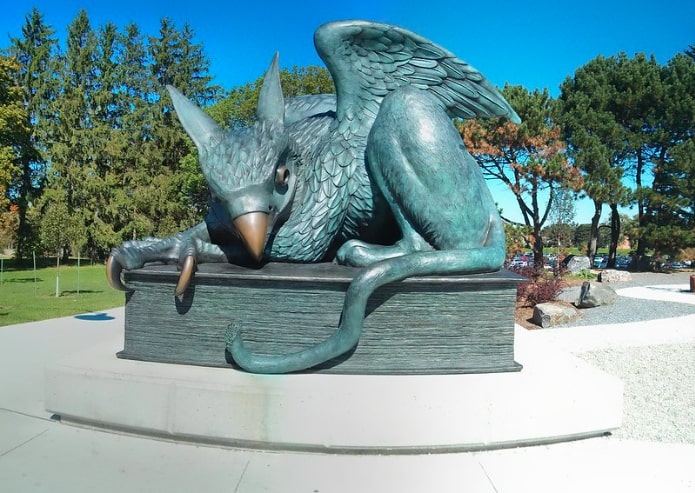
1. Guelph Gryphons
It is hard not to pick the mystical creature that is half lion and half eagle. Guelph changed the game, combining the best aspects of the apex land predator and a bird of prey. The Gryphon would be a menace in both trenches, while also having the ability to take flight. A versatile creature that would have no problem destroying their competition on both sides of the ball. I don't just think the Gryphons would be undefeated, I believe each victory would be vicious and indisputable.