
Sudbury is no stranger to basketball greatness. Fans of the Laurentian Voyageurs still remember the dominance of the 1990s, where the university captured two Wilson Cups in three seasons. They still remember Kadre Gray, a talented guard winning three straight OUA MVPs. They still remember Shawn Swords, a nationally recognized coach who held down Northern Ontario for years.
As amazing as all those memories are, they all reside in the past. In recent years, Laurentian has struggled to compete in a highly competitive OUA East division, featuring recent champions Ottawa, Carleton, and Queen’s.
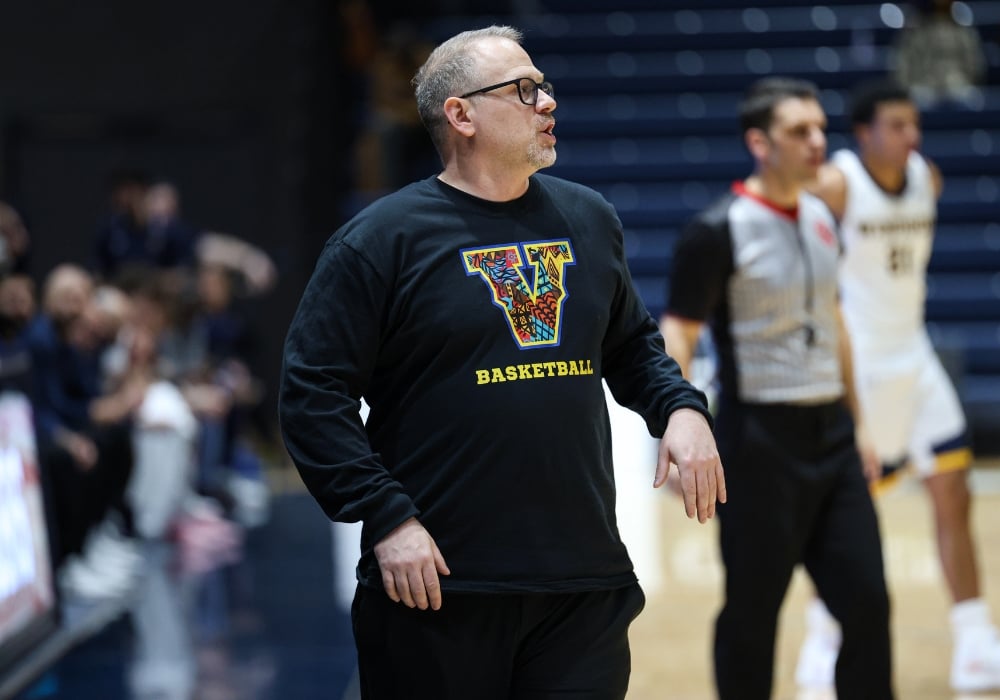
Although many of Sudbury’s great basketball moments have faded to stories, there is a new era of Voyageurs basketball ready to take over. And it's being led by Brandon Edwards.
A native of Gatineau, Que., Edwards is entering his third season as head coach of Laurentian, and there are early signs of a rebuild that OUA fans can no longer ignore.
In his first season at the helm, the Voyageurs would finish 4-18. But just one year later, the team – reinforced by key transfers – would turn around their fortunes and finish a respectable, 11-11, qualifying for the playoffs and defeating the Windsor Lancers in the opening round.
They would get knocked out in the quarterfinal, losing to Ottawa, who would go on to win their second Wilson Cup in three seasons. Despite being bounced out of the playoffs, the season made a statement. Laurentian basketball is on the rise once again.
Building on Momentum
Edwards' coaching journey began far from the northern cold of Sudbury. He would attend college in the Quebec CEGEP system, playing basketball and baseball for Heritage, the only English-language college in western Quebec.
After being pulled towards coaching, Edwards would step into the head coaching role at his alma mater in 2011.
For the next eight seasons, he would lead a program built on discipline. One of his crowning achievements would come in the 2018-19 season, when Heritage went 40-1, capturing the schools first and only provincial championship.
“The nature of CEGEP basketball in Quebec is really transient — players are in and out a lot with academics,” Edwards remembered.
“It forced me to be flexible, to be efficient with my time, and to build relationships outside of the gym. That’s where I learned the value of daily touch points with players, of making sure they know you care beyond just basketball.”
After his success with Heritage, Edwards would make the jump to coaching professional basketball in the CEBL, joining the Ottawa Blackjacks as an assistant in the 2020 bubble in Niagara. This experience would give him insights into his own coaching, lessons he still carries with him today.
“The CEBL gives U SPORTS athletes a roadmap,” Edwards said. “It shows them what it takes to play at the next level, and that very few of them are going to be asked to score 25 a night. You have to understand your role, bring something else to the table, and accept it if you want to stick.”
His time in the CEBL also made clear what his main responsibility is at the U SPORTS level.
“My job is to make players better people and better players, and if they’re good enough, they’ll continue. But the reality is, most won’t. And that’s okay,” he said.
“It’s about helping them transition into the next phase of life, making sure they leave here prepared, with an identity that goes beyond basketball.”
Newcomers & Returning Stars
The Voyageurs will enter the new campaign looking to fill in some gaps. Nginyu Ngala and Kamil Dia Hantchi, two key starting guards, transferred to Kansas and Ottawa respectively in the offseason and will need to be replaced.
“You lose both of those guys, right, leaves a bit of a void at the guard position,” said Edwards. “We’re bringing in some guys that I think are going to be thrust into roles and, you know, they’re gonna have to learn on the fly and they’re gonna have to learn through mistakes.”
Among the new recruits, Jaylen Forde and Angel Castellanos stand out.
“I think Jalen Ford has a great opportunity to contribute. I think Angel Castellanos Gutierrez from Spain has a great opportunity to help us. Angel brings some experience having played at the junior college level and being a little bit older. I think that certainly helps.”
Still, Edwards emphasized the importance of last year's returning players having contributing roles. “If you’re needing incoming recruits to make massive change, your program’s probably not in a good place.”
He highlighted fourth-years Pierre Mukandila and Favour Ugbah, third-years Ismael Konate and Daniel Muila-Mwaka and sophomore guard Brice-Philippe Fandio, who made the OUA All-Rookie team last season.
“The impact that we need is for specific players that showed some good signs of development and growth last year to really step up,” said Edwards.
“Each of the guys coming in is going to get an opportunity… but it’s now going to be incumbent upon them to take a big step forward.”
Winning culture
Edwards is no stranger to winning. Having led Heritage to a historic season, he would take his talents to the Niagara region and join the Brock Badgers coaching staff in the fall of 2019.
It wouldn't take long for the team to find its footing. In 2022, Brock beat the Queen’s Gaels in the OUA final to capture the Wilson Cup. That run gave Edwards the opportunity to absorb what a winning culture looked like under Willy Manigat.
“Talking about winning is a waste of time,” he said. “It’s about daily habits — possession by possession, practice by practice. The less you focus on results, the more you focus on doing your job at a high level, the more the winning takes care of itself.”
Being around great coaching minds has rubbed off on Edwards. He credited a number of mentors who have shaped his leadership style. Manigat at Brock, Carleton’s Dave Smart – a legend among Canadian basketball circles – Heritage colleague Matt Greer, high school coach and administrator George Singfield, as well as two different coaches named Pat Sullivan, one from Ottawa and one from Niagara.
But one of the more profound interactions came at a Laurentian alumni event, when he found himself chatting with Ken Shields, a legendary Canadian basketball coach who won seven straight national titles with the University of Victoria and later led the men’s national team.
“[Coach Shields] talked about the agreement between coach and athlete — that both commit to doing their best, for as long as they can, to be at their best when their best is needed,” Edwards recalled.
“He said the players who honoured that commitment never struggled with identity after their careers ended, because they knew they had given their all, and because you learn a lot about yourself through that commitment to excellence. That really stuck with me.”
The Bigger Picture
When asked how his CEBL experience shaped his U SPORTS approach, Edwards identified two main lessons.
“It's given me really two things, if I'm being completely honest with you. One is there's a roadmap to success and developing a sound understanding of the game, developing an acceptance of maybe what you're going to be as an athlete at the next level, and playing a role.”
He emphasized that too often we see athletes assume scoring is the path to the pros.
“Sometimes we get enamoured with scoring and we think that the easiest way to become a pro is to put up 26 points a game or 25 points… but in reality at the pro level, it's very unlikely that a Canadian U SPORTS kid is going to be asked to go and score 25, right, wherever they go in the world.”
The CEBL shows U SPORTS players the importance of adaptability. “Great, you can put the ball through the hole, but what else can you do, right? What else are you going to bring that they want at the pro level?”
The second lesson was even bigger for Edwards, understanding that the majority of student-athletes won’t continue with their sport after their university careers.
“At the level that I'm at, the reality is, we know the percentages… I think if you sort of look at that number relative to U SPORTS, to the professional game, I can't imagine the number is greater than probably 5 per cent of U SPORTS players go and play and continue playing after their university career.”
That perspective shift reshaped the way he approached coaching, “My job as a university coach is to help players get as good as they can to become better people and to become better players. And if they're good enough, they can continue in their sport, but the vast majority will likely not continue playing basketball. And that's not because I don't believe in them, or it's not because they're not good. It's just the numbers game, right? It's a proven fact.”
For Edwards, preparing players for life after basketball is now central to his philosophy.
“After playing four or five years of U SPORTS, if you don't continue playing pro, you're not a failure. But it might feel like that if you've never taken time to help prepare the athlete to transition into the next phase of their life. And I think that that's become very clear to me.”
Ultimately, the CEBL reinforced why Edwards loves coaching.
“When we talk about winning culture… part of it is reminding yourself, why you do what you do, and what the actual goal is here. And I think the goal that we all have is to help our student athletes grow and develop. And for me, the CEBL has shown that whether it's through basketball or not… if you don't make it to that level, it doesn't mean you're a failure. It just means there's really, really good players out there. And are you going to be okay with transitioning to the next phase of your life? And if the answer to that is yes, then I think I did my job.”
Looking Forward
In many ways, the lessons learned along the way have helped Edwards with the challenges of coaching in Sudbury. Laurentian doesn’t have the resources of Queen’s or the recruiting hotbed of Toronto or Ottawa. What it does have is a program with history, and a next chapter that is still yet to be written.
“It’s about making sure Laurentian basketball matters again,” he said. “And the only way to do that is to keep working, keep growing, and keep believing in what we’re building.”
The road forward won't be easy. Laurentian will have to part with key members of last year's roster, and find new players to step into those roles. The OUA remains a highly competitive conference, with key matchups waiting for you every week.
But for Edwards, that’s just another part of the pitch.
“You don’t come to Laurentian because it’s the easy path,” he said. “You come here because you want to build something, because you want to be part of a team that’s fighting for respect every night. That’s the challenge, and that’s the opportunity.”
As Laurentian gets ready for the new season, the program finds itself trending upwards for this first time in years. The only question that remains, can they return to the glory days? Under Brandon Edwards, the foundation is certainly in place.