

There is no hiding in February. Every possession becomes a referendum on identity, and these two Canada West semifinals are a clash of styles.
On one side, UBC meets Winnipeg. The Thunderbirds average 85.0 points per as one of the top offensive units this season. But, the hosting Wesmen have limited vistitors to just 69.0 points per game in their home barn.
On the other side, Victoria faces Alberta. The Vikes, who reached this stage a year ago, show little sign of slowing down in their quest to repeat. The Golden Bears favour a more deliberate approach and rely on experienced guard play to force opponents into contested shots.
Two games. Four programs. One weekend.
Don’t miss a single semifinal buzzer-beater — here’s your breakdown of this weekend’s upcoming action.
Semifinal 1: Victoria Vikes (17-3) vs Alberta Golden Bears (13-7)
Quarterfinal results: Victoria defeats TWU 95-67, Alberta defeats UFV 80-66
Victoria plays at a pace few teams can match and defends with the discipline to sustain it. The Vikes finished 17-3 in conference play, averaging 88.2 points per game while holding opponents to 71.9. The result was a conference-best plus-16.3 scoring margin, built on relentless perimeter creation and a frontcourt capable of finishing through contact. When Victoria finds rhythm early, it can overwhelm teams for extended-stretches.
The Vikes are comfortable playing in the high 80s and low 90s. Alberta prefers games in the 70s and low 80s, where efficiency and execution outweigh shot volume. Defensively, the teams are nearly identical, each allowing about 72 points per game. The separation comes on the offensive end, where Victoria’s scoring output creates a clear edge, as they do against most teams.
Key players
Victoria
Ethan Boag (14.1 points per game) sets the tone. The Canada West first-team all-star can score in isolation and punish single coverage inside and out.
Renoldo Robinson (13.1 points per game) adds versatility. The third-team all-star is capable of creating his own shot and shifting momentum in every facet of the game.
Shadynn Smid (12.9 points per game), a second-team all-star, provides interior efficiency and balance. If Victoria’s perimeter attack stalls, Smid stabilizes it.
Alberta
Isaac Simon (15.8 points per game overall; 16.7 in conference play) drives the Golden Bears’ offence. If Alberta is to advance, it will be because Simon inflicts his tempo and limits empty possessions.
Kyle Varner (13.0 points per game) stretches the floor. He has made 67 three-pointers at 41.1 per cent overall. When he is efficient from deep, Alberta’s spacing forces defences into difficult rotations.
What will decide it
Victoria shoots 77.0 per cent from the free-throw line. If Alberta fouls excessively, the Vikes can build scoring runs without needing clean half-court looks. Alberta must finish defensive stands with rebounds. Boag, Smid and Tyler Felt extend possessions and generate second chances, giving Victoria's scoring a layered attack not limited to just the perimeter.
Semifinals often hinge on the final two minutes. Alberta’s experienced guards are comfortable in controlled, late-clock scenarios. Victoria’s offence, however, has shown it can create separation before those moments arrive.
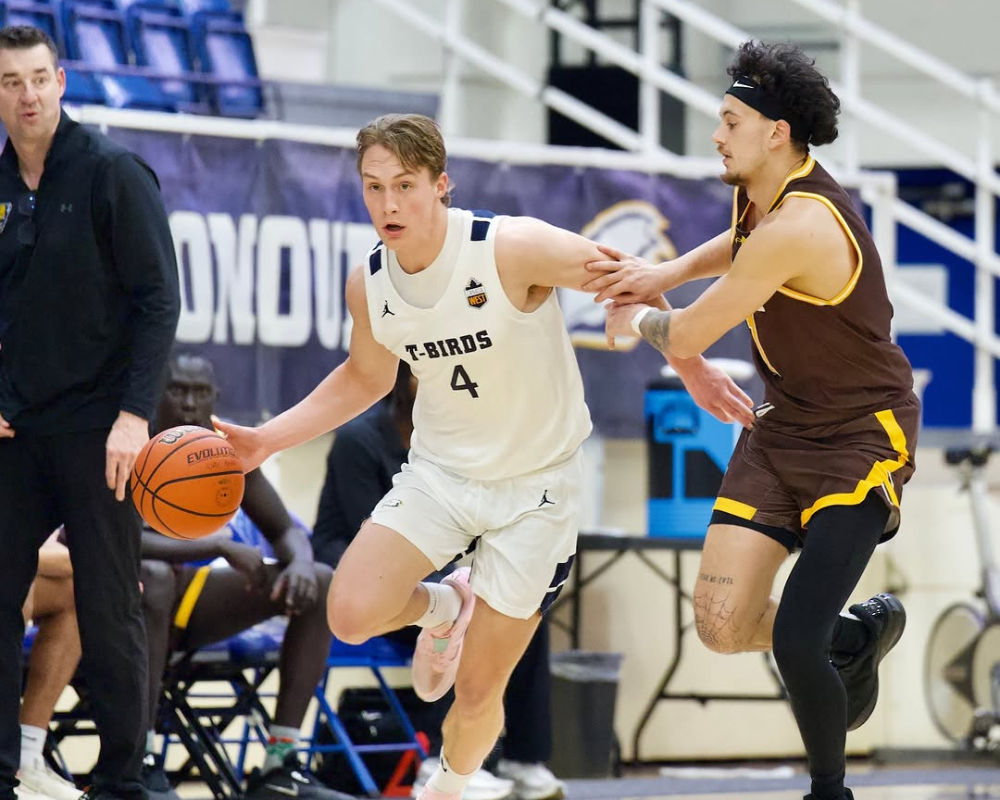
Semifinal 2: UBC Thunderbirds vs Winnipeg Wesmen
Quarterfinal results: UBC defeats Manitoba 77-69, Winnipeg defeats Calgary 82-69
This is the clearest stylistic contrast of the semifinal round. UBC seeks to convert possessions into points. Winnipeg aims to turn possessions into headaches.
The Wesmen presents the most balanced two-way profile of any team in the Final Four. But The Thunderbirds' frontcourt efficiency, length, and floor spacing is a handful to contain.
UBC has the higher offensive ceiling. Winnipeg has the cleaner defensive floor. That’s why this game is terrifying for both teams: UBC can’t assume points will come easily, and Winnipeg can’t assume its defence will be enough if the T-birds catch fire.
Key players
UBC
Nikola Guzina leads the way with 15.7 points per game overall and 16.0 in conference play. The Canada West first-team all-star scores efficiently inside, shooting 55.2 per cent from the field.
Nylan Roberts adds versatility. The six-foot-seven forward averages 12.5 points per game, shoots 40.2 per cent from three-point range and contributes 7.0 rebounds per contest.
Holt Tomie, at 11.6 points per game, sets tempo and consistently gets to the free-throw line, where he shoots 82.2 per cent.
All-rookie selection, Edouard Gauthier, rounds out the core at 10.1 points per game.
Winnipeg
Kato Jaro, a Canada West first-team all-star, averages 13.3 points per game overall and 14.9 in conference play while logging more than 32 minutes per night.
Alberto Gordo adds scoring punch at 13.9 points per game overall and 14.8 in league play, while shooting 89.7 per cent from the free-throw line.
Malachi Alexander (11.4), Elijah Mensah (10.9), Donald Stewart (10.3) and Ryan Luke (10.0) provide consistent secondary production.
What will decide it
Winnipeg does not need a single dominant defender on UBC’s star forward. It needs multiple bodies to prevent Guzina from establishing position and finishing in rhythm. The Wesmen will have their hands full. UBC’s attack also features Roberts, Raj Dhadda and Gus Goerzen spacing the floor. If Guzina can draw the extra defender and consistently find the open man, UBC will be difficult to contain.
Winnipeg’s best performances come when it wins the possession battle — forcing turnovers, converting at the free-throw line and managing tempo late. Their recipe this season has been to win with defence, then let Jaro and Gordo manage the final eight minutes.
Schedule
The Golden Bears and Vikes tip off in Victoria at 7PM local time on Friday, Feb.20, while The Thunderbirds and Wesmen take the hardwood 7:30PM on Saturday, Feb. 21.